
Anderson County Court Docket Searches
Anderson County splits its public docket access four ways. There is Circuit Court, Criminal Court, General Sessions Division I in Clinton, and General Sessions Division II in Oak Ridge. Pick the wrong door and a live case can look invisible. So start with the right division. Have the full party name ready. Also bring the case or docket number if you know it, the case type, and the city where the filing or citation began.
The county's official Anderson County docket hub is the place to begin. The clerk's month pages and PDF calendars work well for scheduled matters. They are not full copies of the case file, though. The name and number search on the hub can go down with a server error. So plan a fallback. The monthly Circuit docket pages remain dependable for a setting or a certified copy. So do the two General Sessions month pages and the clerk's office itself.
- Open the county docket hub and choose the court or General Sessions division.
- Use the last and first name or the exact case number when the case search is working.
- Check the relevant month page and open the newest PDF for the hearing type.
- Read the date, setting, court, and case number, then confirm later changes with the clerk.
- Request the docket entries or a certified case record when proof is needed.
Four Anderson County Docket Doors
The county's docket hub is a routing page, not one merged index. Division I handles General Sessions work filed and heard in Clinton. Division II serves the Oak Ridge location. Circuit Court carries general civil jurisdiction and appeals. Criminal Court takes the higher criminal docket. The public PDFs vary by page too. A Division I month may hold jail, state, civil, traffic, pre-jail, and updated dockets. A Circuit month may add regular calendars, jury material, or docket sounding. The county source lays out that four-way starting point. Its layout shows why picking a venue is part of the docket search rather than a minor filter.
One division's calendar proves nothing about another court. Never treat it as evidence that a different Anderson County court has no case or setting on file.
Court Dockets: What They Show
In Anderson County, a court docket can mean three things: a monthly hearing list, a case register, or the court's internal schedule. The public PDF calendars are only snapshots. Depending on the court, an entry may show an item number, case number, case style, filing date, attorney, charge or cause, bond, judge, and setting type. The clerk's case record runs deeper. Pleadings, motions, orders, judgments, minute entries, and papers that never touch a public calendar all live in that file.
| Case Number | The court's file identifier and best search key. |
|---|---|
| Parties | The case style, which differs for civil and criminal matters. |
| Docket Entries / Filings | A dated register in the clerk's file, not always reproduced in calendar PDFs. |
| Hearing Settings | The date and purpose, such as arraignment, plea, motion, trial, or docket sounding. |
| Court & Judge | The division and judicial officer assigned to that setting. |
| Disposition | The result recorded by the court; a pending charge or setting is not a disposition. |
PDF Calendar or Case File
The gap is practical, not technical. A monthly PDF tells you when a matter is set. It may name its hearing type too. Yet it can miss a continuance, a filing, an exhibit, a payment, a warrant, a sealed item, or the final order. The Anderson County Circuit Court Clerk prepares daily dockets. The clerk also retains and preserves records for long-term use. That clerk-maintained file is what to request. Ask for it when you need the result, the full history, or a certified copy.
| Source | Best Use | Limit |
|---|---|---|
| Monthly PDF | Check a scheduled setting | Calendar snapshot only |
| Online case search | Locate by name or number | Service may be unavailable |
| Clerk case file | Review entries and request copies | Access and fees depend on the record |
The Circuit Court Clerk page shown here describes the office's docket and preservation duties.
That retention duty is the point. For an Anderson County court record, the clerk, not a copied PDF, is the final source.
Anderson County Courts and Their Dockets
Anderson County keeps several custodians because each court plays a different role. Circuit and Criminal Court are courts of record with general jurisdiction. General Sessions handles limited civil claims, misdemeanors, felony preliminary hearings, and local state or traffic matters. Juvenile Court holds restricted family and youth records. The Clerk and Master keeps a separate Chancery docket for probate, divorce, land, child-support, and related equity matters. City courts handle municipal citations and ordinance cases.
| Court | Docket Covers | Where to Search |
|---|---|---|
| Circuit / Criminal Court | General civil, felony criminal, and appeals | Circuit Court Clerk |
| General Sessions I and II | Limited civil, misdemeanors, preliminary hearings, traffic | Division clerk and monthly dockets |
| Chancery / Probate | Equity, estates, domestic matters, land disputes | Clerk and Master |
| Juvenile Court | Juvenile and family matters | Juvenile clerk, subject to confidentiality |
| Municipal Courts | City ordinance and municipal citation matters | Each city's clerk or court |
The county court information view illustrates these jurisdiction lines.
Picking the right line saves time. It also keeps a city citation from being mistaken for a county criminal case.
Two General Sessions Divisions
General Sessions is divided by geography as well as case type. Division I sits at the courthouse in Clinton. Division II sits at 728 Emory Valley Road in Oak Ridge. Current civil fee material says a case filed in one division stays there to be heard. Staff at the other office cannot move or hear that file. Don't assume they can fully answer for it either. The online venue instructions draw the same line.
Phone numbers follow the split. For Division I, the county publishes 865-264-6323, and the fee sheet also lists 865-457-6214. Division II publishes 865-259-6963, with 865-259-6962 on the fee sheet. Where contact or hour details conflict, confirm before you drive over. Follow the division printed on the docket or filing, not the office closest to you.
Court Dates and Settings in Anderson County
Pull the newest calendar for the right court, month, and setting type. A setting names the purpose of an event, not necessarily the final trial. Anderson County PDFs may separate jail, state, traffic, pre-jail, plea, negotiation, docket sounding, jury, and other calendars. Updated files can replace earlier versions. Check the file date. Then call the clerk if an appearance is near or an entry reads unclear.
A reset only moves a hearing. It does not dismiss the case. A continuance can come by court order or an allowed request. Only the court can change a setting. The full Anderson County court schedule walks through calendar fields and missed-setting steps.
Anderson County Docket Sounding
Civil cases in Circuit Court get their own docket-sounding step. The public sample tells you plenty. It lists the case number, case type, cause, filing date, attorneys on each side, status, and the setting. Docket sounding lets the court check readiness. It sorts out scheduling for the civil matter. That stage is not the trial, and it is not a judgment. Local Rule 119.05 adds another layer: once a civil jury or bench trial is set, a scheduling order follows soon after, covering deadlines for witnesses, exhibits, discovery, and proposed jury instructions.
So read the setting label with care. That label marks a scheduling stage only. A later trial date, order, or outcome must be confirmed in the case file itself.
Docket Access Under Tennessee Law
The starting point is Tennessee Supreme Court Rule 34. The rule presumes public access. Still, it recognizes limits created by law, by rule, by court order, or by the need to protect the judicial process. An Anderson County docket stays open, with limits. Sealed records, protected personal data, and confidential juvenile material can be withheld or redacted. The Tennessee Public Records Act covers many government records. A request for a court case file should go to the court or clerk that maintains it.
Key Rules:
Supreme Court Rule 34 states the court-record access baseline and permits local access policies.
Supreme Court Rule 114 protects confidential juvenile and family proceedings.
Tennessee Public Records Act guidance explains inspection and copy rights for qualifying public records.
Restricted Anderson County Dockets
Juvenile cases follow a different route. There is no public juvenile search at the county docket hub. Questions go to the juvenile clerk. That matches Tennessee's separate confidentiality rule. Adoption, child-support, conservatorship, probate, and domestic files can also contain protected material. Even when a case's existence is public, a filing inside may be sealed, redacted, or released only under a court's conditions.
A missing search result proves nothing. It can reflect the wrong division, a portal outage, a recent filing, a spelling mismatch, confidentiality, or a sealed record. Ask the clerk whether a public index entry or a redacted copy is available. Do not chase private details through unrelated commercial databases.
How the Clerk Keeps Docket Records
Circuit Court Clerk Rex Lynch keeps Anderson County's court records through separate desks for Circuit, Criminal, General Sessions, and Juvenile matters. The main clerk sits in Suite 301. You will find it at the Anderson County Courthouse, 100 North Main Street, Clinton, Tennessee 37716. The main number is 865-463-6821. Circuit and Criminal staff answer at 865-463-6822. Give the court, division, case number, record needed, copy type, and preferred delivery, and call first about fees and accepted payment.
Anderson County Circuit Court Clerk
100 North Main Street, Suite 301
Clinton, TN 37716
865-463-6821
The contact page captured here identifies the separate desks and their public contact routes.
The right desk matters like a case number. Get both right, and the request moves.
Anderson County Copy Costs
The 2026 Circuit fee sheet keeps it simple. Plain copies run 50 cents per page. Certification with the seal costs $5. The office takes cash, cards, money orders, and cashier's checks, but not personal checks, and filing fees are nonrefundable. Those terms belong to the Circuit schedule alone, so do not assume them for a city, Chancery, archive, or special record request.
| Item | Published Amount |
|---|---|
| Circuit copy | $0.50 per page |
| Certification and seal | $5 |
| Appeal or cost bond | $300 |
Historical county records follow a different Archives schedule. Ask the holding office for an estimate before mailing payment or requesting a large set.
Historic Anderson County Court Records
Old Anderson County court records live at the Archives. The holdings reach back to 1811. Non-current permanent records run from that year to the present, spanning court, Circuit, Chancery, divorce, probate, will, estate, marriage-bond, and tax files. That range makes Archives a favorite stop for genealogy. It serves historical research well, but it cannot replace the active clerk file or a current hearing calendar.
The Tennessee courthouse finder from the state courts site gives another official way to verify Anderson County court locations.
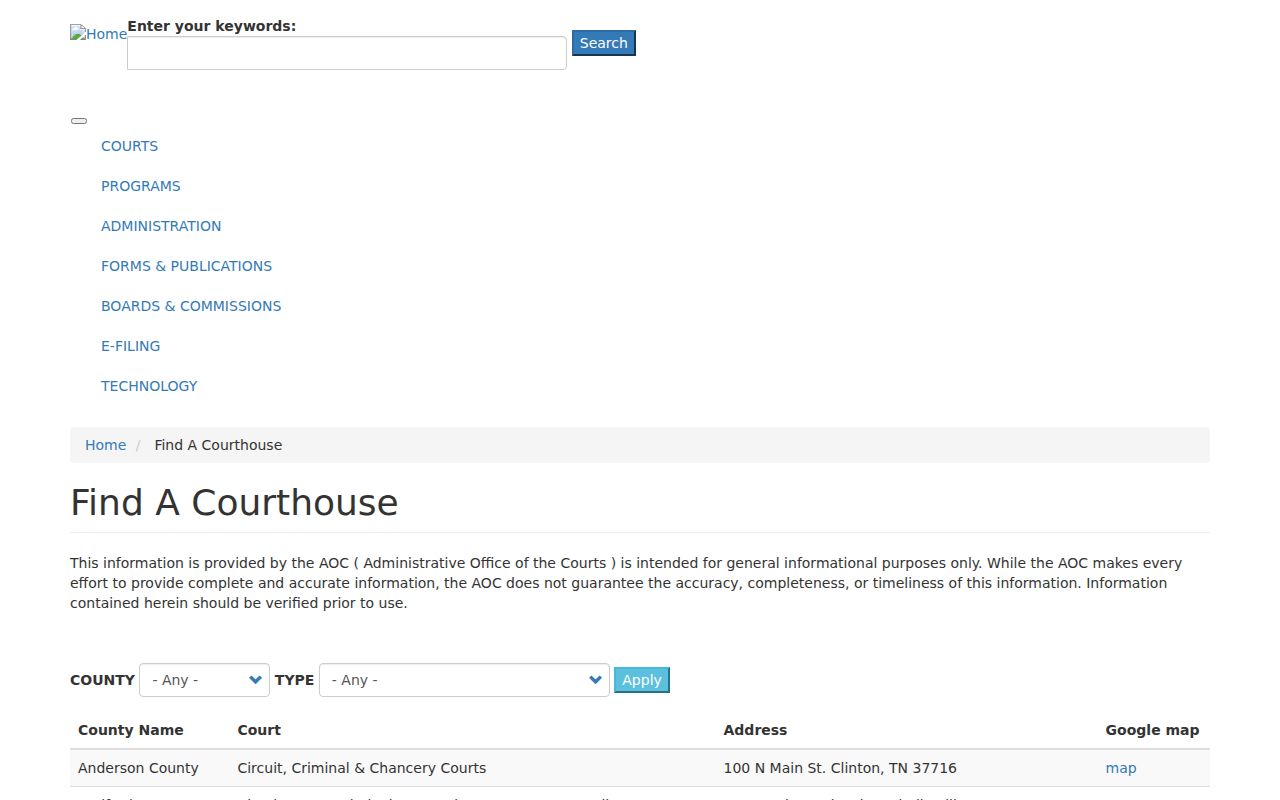
Check the room number before you go. Court offices across Anderson County sit in separate buildings, and each one keeps its own records.
Seventh Judicial District Context
Anderson County sits in Tennessee's Seventh Judicial District. State appellate case history can help you locate an appeal. But it is not a trial-court docket search and does not supply every underlying filing. Trial court e-filing varies by local system as well. Tennessee Rule 5B permits electronic filing under local procedures. Rule 46B permits email filing only where a court has adopted a process. So a published email address is not permission to file or serve a document. The official district profile names the district and its court personnel.
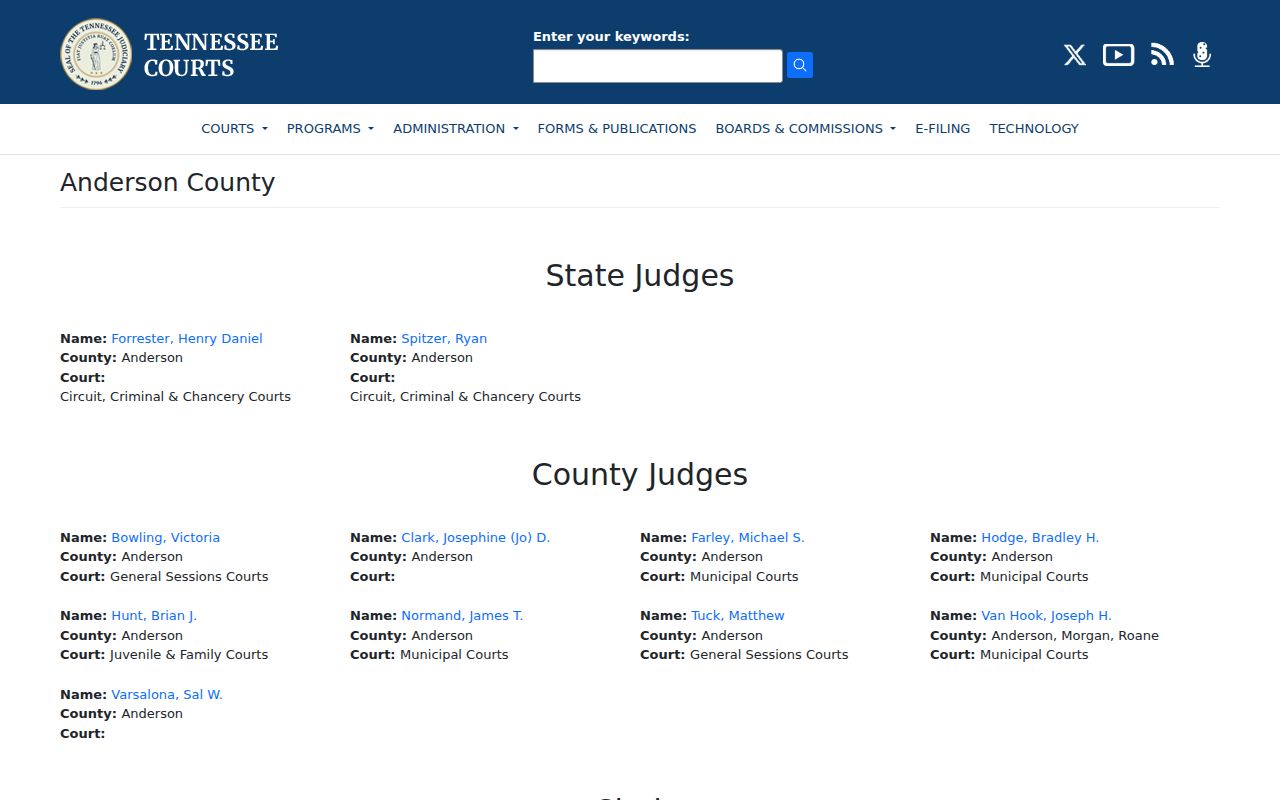
Treat the district layer as a way to verify what you already have. The Anderson County clerk still keeps the local trial record.
City-by-City Court Dockets in Anderson County
Each of the county's five largest incorporated places, by 2020 Census count, has its own municipal route. City courts in Anderson County handle ordinance and citation matters rather than the full county civil or criminal docket. Three of them cross county lines: Oak Ridge, Oliver Springs, and Rocky Top. That makes the place of filing and the issuing agency matter. For municipal court questions, call the city clerk. For anything on a state-court filing, use the county division listed on it.
Oak Ridge Court Records
31,402 · Municipal ordinance and traffic matters
Clinton Court Records
10,056 · City citations and ordinance cases
Oliver Springs Court Records
3,297 · City tickets and municipal matters
Rocky Top Court Records
1,628 · Municipal ordinance and traffic cases
Norris Court Records
1,599 · City court matters routed through City Hall
Map and Directions to the Anderson County Courthouse
Circuit, Criminal, and General Sessions Division I records are kept at the Anderson County Courthouse, 100 North Main Street, in downtown Clinton. The Circuit Court Clerk's main desk is in Suite 301. Clerk & Master (Chancery, probate, and child support) is in Room 308 of the same building, and County Archives is in Room 101, so several county record offices share this one address even though each keeps a separate docket.
Anderson County Circuit Court Clerk
100 North Main Street, Suite 301
Clinton, TN 37716
Monday through Friday, 8:00 a.m. to 5:00 p.m.
865-463-6821
Published hours vary by office within the same courthouse — General Sessions lists 7:30 a.m. to 5 p.m. and Clerk & Master lists 8:30 a.m. to 4:30 p.m. — so confirm the desk's own hours before a trip. General Sessions Division II and Juvenile Court sit at separate addresses outside this building; no public self-service terminal is advertised, so ask staff whether one is available.